Welcome to my G321 Foundation Portfolio Blog.
Here is a post to highlight the key areas of my blog.
My finished construction of my Thriller Film Opening Sequence can be found here on YouTube or here on my blog. All other posts labelled "construction" can be found here.
Here are the links to each of my evaluation questions: 1, 2, 3, 4, 5, 6 and 7
All posts labelled "planning" can be found here.
All posts labelled "research" can be found here. "Audience Research" posts can be found here.
All other posts will have a corresponding label on the right hand side of my blog for easy navigation.
I hope you enjoy looking through my blog.
Joe Weston.
Wednesday, 23 April 2014

Monday, 7 April 2014
Film in the Digital Age - Questions and Extra Notes
1) What is the advantage of using moving image story boards?
Moving Image Story Boards were first pioneered in 1992 by Francis Ford Coppolla during the production of Bram Stoker's Dracula, and involve the directors and cinematographers utilising an 'electronic stimulation' of the story or scene that is to be created on a certain day, instead of using hand drawn, inanimate storyboards to 'pitch' a film or organise the crew. This creates many advantages - firstly, time is saved as less time will be spent constructing detailed sketches and drawings to detail the scene, and the moving image story boards provide a more accurate visualisation of what is to be shot so the crew can more easily replicate the storyboard.
2) What is the advantage of using DV Video Cameras?
The use of Digital Video (DV) Cameras to film documentaries and full length films is increasing, due to the many advantages this new technology has over celluloid film. Firstly, DV Cameras are more mobile, are lighter and much more practical and easy to use overall. The cost of shooting scenes and editing is also reduced as they do not need the expensive film stock, nor does their video require processing in the same manner. Complex scenes can be organised more easily also, as complicated lighting systems that are needed when shooting on celluloid are not needed.
3) What are the two types of CGI? What are the advantages and disadvantages of CGI?
CGI, or Computer Generated Imagery, is also seeing increased use in the film making processes. There are two types of CGI; Invisible Special Effects, which according to Buckland (1999) contributes to up to 90% of all of the work of the special effects industry, are not meant to be noticed, hence the name, by film spectators, and then Visible Special Effects, which produces "out-of-this-world" images to captivate audiences in a way that would not be possible otherwise. The advantages of CGI is that more elaborate and complex creations can be made that are both aesthetic and life like with the development of technology - however, CGI has also become more widely available to the public, with digital effect software reaching domestic audiences, and is sold by electrical retailers to enhance home videos and GCSE / A Level Productions.
Moving Image Story Boards were first pioneered in 1992 by Francis Ford Coppolla during the production of Bram Stoker's Dracula, and involve the directors and cinematographers utilising an 'electronic stimulation' of the story or scene that is to be created on a certain day, instead of using hand drawn, inanimate storyboards to 'pitch' a film or organise the crew. This creates many advantages - firstly, time is saved as less time will be spent constructing detailed sketches and drawings to detail the scene, and the moving image story boards provide a more accurate visualisation of what is to be shot so the crew can more easily replicate the storyboard.
2) What is the advantage of using DV Video Cameras?
The use of Digital Video (DV) Cameras to film documentaries and full length films is increasing, due to the many advantages this new technology has over celluloid film. Firstly, DV Cameras are more mobile, are lighter and much more practical and easy to use overall. The cost of shooting scenes and editing is also reduced as they do not need the expensive film stock, nor does their video require processing in the same manner. Complex scenes can be organised more easily also, as complicated lighting systems that are needed when shooting on celluloid are not needed.
3) What are the two types of CGI? What are the advantages and disadvantages of CGI?
CGI, or Computer Generated Imagery, is also seeing increased use in the film making processes. There are two types of CGI; Invisible Special Effects, which according to Buckland (1999) contributes to up to 90% of all of the work of the special effects industry, are not meant to be noticed, hence the name, by film spectators, and then Visible Special Effects, which produces "out-of-this-world" images to captivate audiences in a way that would not be possible otherwise. The advantages of CGI is that more elaborate and complex creations can be made that are both aesthetic and life like with the development of technology - however, CGI has also become more widely available to the public, with digital effect software reaching domestic audiences, and is sold by electrical retailers to enhance home videos and GCSE / A Level Productions.
Tuesday, 1 April 2014
Different Lighting Techniques
In this extract, different lighting techniques are used to make certain aspects more apparent to the audience.
At around 0:20, hard lighting is used during the conversation between the men. This hard lighting allows for the viewer to clearly see the definition in his face and the details of his scars quite clearly, and allows for the other men's facial expressions to be clearly identified. The key light is placed on the corresponding side of the man's face, which subsequently casts a shadow onto the van, which aids adding detail to the injuries the man has suffered.

Natural lighting is used to create a dull and gloomy atmosphere for this scene to perhaps reflect the mood at 0:25, when the character is viewed from a different perspective, and less detail is given to the scars on the left side of his face, which is partly obscured. The fill light is placed to the back right of the man, as there are little shadows cast here yet we can see the detail in the man's hair. By contrast, the details of his face are not in full light and not as prominent, showing the character as more "normal".


Monday, 31 March 2014
How does Piracy affect Working Title and how have they tried to stop it?
Piracy is a crime that effects the production, distribution and exhibition of the film industry in the UK. With Hollywood investigators claim that Piracy has increased by 10% each year from the amount of revenue lost to illegal distribution. This is largely due to technological advances in internet speeds and broadbands, allowing for the faster distribution of files online, and increased confidence in computers and torrents en masse, and the fact that the quality of these torrents is improving so that the "consumer" obtains a better quality of the film. Approximately 77.75 Million counterfeit DVDs were sold in 2009, resulting in an effective monetary gain to criminals of £278 Million. This results in a huge loss to the Industry as a whole, £700 Million overall. This means smaller studios have less money to invest in future projects and produce further films, restricting creativity and overall reducing the choice of films that will be available to the consumer.
Companies such as Working Title have endeavoured to prevent piracy from effecting their profits. Working Title have also used the advancements in technology to produce higher definition films, creating a distinction between the legal and illegal copies, through blu-ray discs. Similarly, 3D films are produced, which aren't as readily available for the public to obtain, and create a unique viewing experience that isn't available through torrents, and blu-ray discs are encrypted with passcodes so they cannot be copied. Furthermore, Working Title distributed Tinker, Tailor, Soldier, Spy, in an encrypted safe, with a passcode to each individual safe, to combat piracy. They also create educational DVDs that inform people on the effects of Piracy to the filmmakers and the industry in an attempt to persuade and convince people, particularly the younger audiences who view Piracy as acceptable, to stop pirating films. Working Title also make their products available instantly online for rental, in a better quality than the alternative torrent download. It could be argued that piracy did allow for technological developments in film, as unique viewing experiences such as IMAX and 3D would not have been developed as much to combat piracy, benefitting the consumer. However, unless piracy is combatted more widely, it could lead to the decline of the film industry in the UK.
Companies such as Working Title have endeavoured to prevent piracy from effecting their profits. Working Title have also used the advancements in technology to produce higher definition films, creating a distinction between the legal and illegal copies, through blu-ray discs. Similarly, 3D films are produced, which aren't as readily available for the public to obtain, and create a unique viewing experience that isn't available through torrents, and blu-ray discs are encrypted with passcodes so they cannot be copied. Furthermore, Working Title distributed Tinker, Tailor, Soldier, Spy, in an encrypted safe, with a passcode to each individual safe, to combat piracy. They also create educational DVDs that inform people on the effects of Piracy to the filmmakers and the industry in an attempt to persuade and convince people, particularly the younger audiences who view Piracy as acceptable, to stop pirating films. Working Title also make their products available instantly online for rental, in a better quality than the alternative torrent download. It could be argued that piracy did allow for technological developments in film, as unique viewing experiences such as IMAX and 3D would not have been developed as much to combat piracy, benefitting the consumer. However, unless piracy is combatted more widely, it could lead to the decline of the film industry in the UK.
Sunday, 30 March 2014
Convergence in a Film Company
An example of a company that has utilised Media and Technological Convergence would be Walt Disney.
Media Convergence: When multiple products come together to form one product with the advantages of all of them.
Digital Convergence: The growing interactive use digital technology in the film industry and media which enables people to share, consume and produce media that was difficult or impossible to do a few years previously.

Media Convergence: When multiple products come together to form one product with the advantages of all of them.
Digital Convergence: The growing interactive use digital technology in the film industry and media which enables people to share, consume and produce media that was difficult or impossible to do a few years previously.
There are many products produced by Disney that are associated with their films, with most of these being aimed at a young audience, such as plush toys and costumes, and a few products aimed at adults such as ornaments. There are many Disney stores worldwide that sell these products and Disney has spread out to many other medias, such as songs being sold on iTunes from their films, most recently Frozen, as well as a variety of other platforms advertised on their website, such as games, interactive activities, TV programmes and an online store. The financial benefit of this to the company is that it creates extra advertising and marketing for the various products - social networking accounts for respective films to generate interest, and then various products to sell alongside the film means extra profit can be generated.
Thursday, 20 March 2014
Convergence in Websites
The Hobbit

The
website for “The Hobbit” uses convergence to increase audience awareness about
the film. On the “Features” tab of the website, there are a variety of
activities including “A Journey Through Middle Earth” and “Play Barrel Escape”.
These verbs allows for audience participation and engagement with the film to
sustain interest in the film- the audience that would be attracted to this, a
young audience or young adolescents, could play the games and discuss them with
friends and then go to see the film. Other forms of convergence have been used:
Lego: The Hobbit is to be released on console platforms that will appeal to the
target audience.
The Lego Movie

There
is a variety of different integrated games to appeal to the younger audience of
the film. There is a feature on the website to create your own Lego character
and various other interactive games that are easy to play, and hence will be
played by young children and will spread as their friends play it. A
PlayStation game for the Lego Movie has also been released, which although
gives away the storyline, will help to attract a wider audience and get more
people to watch the film.
How does Editing represent Disability in "The Street"?
In the extract from "The Street", editing is used to create a negative representation of disability.
At the start of the scene, the use of shot reverse shot during the exchange between the disabled character and his former co-workers allows for focus on the expressions of the other men when they look at the man's face and answer his questions. The other men seem surprised and shocked that the man will get his job back, and the disabled man is hence represented as inadequate. A focus pull is used at the end of this section to show the man through a barbed wire fence, signifying the physical barriers he must overcome amongst other members of society. In the section where he approaches the woman who has dropped her shopping, a long shot is used to show the man's change in pace as he goes to her aid, contrasting stereotypical negative representations of disability. However the woman's reaction is shown negatively, by using eyeline match alongside an over the shoulder shot. Shot reverse shot is used when they are walking away when he tells her to "stop digging", and a sound bridge builds to represent his anger at the views society has towards his disability when he is trying to assist the public. The editing pace increases for the street segment alongside the diegetic soundtrack to enhance the notion of him being alone in society, and ellipsis between each of the 4 sections creates a representation of the man being an exile and outcast in each one of the four sections, matching the stereotyped representation of disabled persons being a burden and a victim. In the final section, the 180 degree rule of continuity is broken, so the man is shown to be looking in two different directions during the conversation - this is used as a technique for representation as it shows the "two sides" to the man's appearance and character - one side of his face is disfigured, and covered by the shadows in the scene, which connotes a representation of having a split personality. This exchange also shows an angry side to his character, as opposed to the positive side shown in the section with the woman. Eyeline match is also used here to show the reactions of the Sergeant towards the man, and hence the main negative representation in the scene is the views of society towards disabled people.
Sunday, 16 March 2014
Monday, 24 February 2014
Why is British TV Drama popular?
British TV Drama continues to attract large viewing audiences- many of which watch programmes as a one-off at peak-time broadcasts: this provides evidence that we are not consuming all of our media, and that we are instead turning to YouTube or other online services for all of our media.
British Dramas such as Coronation Street and Lewis attracted audiences in excess of 12 Million viewers, with programmes such as Call the Midwife attrracting 8.71 Million viewers. Call the Midwife is a BBC period drama set in East London that has been shown from 2012 to the present. A medical drama in a series of episodes, the programme is one of the most popular nationwide.
I think TV Drama is popular for a number of reasons- firstly, people may be able to relate to certain incidents recreated in the programmes, although they are often over-dramaticsed, or just find them exciting or entertaining. The programmes may form some kind of distraction from other activities and become part of a daily routine for many people nationwide.
British Dramas such as Coronation Street and Lewis attracted audiences in excess of 12 Million viewers, with programmes such as Call the Midwife attrracting 8.71 Million viewers. Call the Midwife is a BBC period drama set in East London that has been shown from 2012 to the present. A medical drama in a series of episodes, the programme is one of the most popular nationwide.
I think TV Drama is popular for a number of reasons- firstly, people may be able to relate to certain incidents recreated in the programmes, although they are often over-dramaticsed, or just find them exciting or entertaining. The programmes may form some kind of distraction from other activities and become part of a daily routine for many people nationwide.
Friday, 21 February 2014
Wednesday, 19 February 2014
Monday, 17 February 2014
Evaluation - Question 2 - Draft
How does your Media Product represent particular social groups?
http://prezi.com/sbi1ael9wkqg/?utm_campaign=share&utm_medium=copy
http://prezi.com/sbi1ael9wkqg/?utm_campaign=share&utm_medium=copy
Evaluation - Question 4
Who Would Be The Audience for your Media Product?
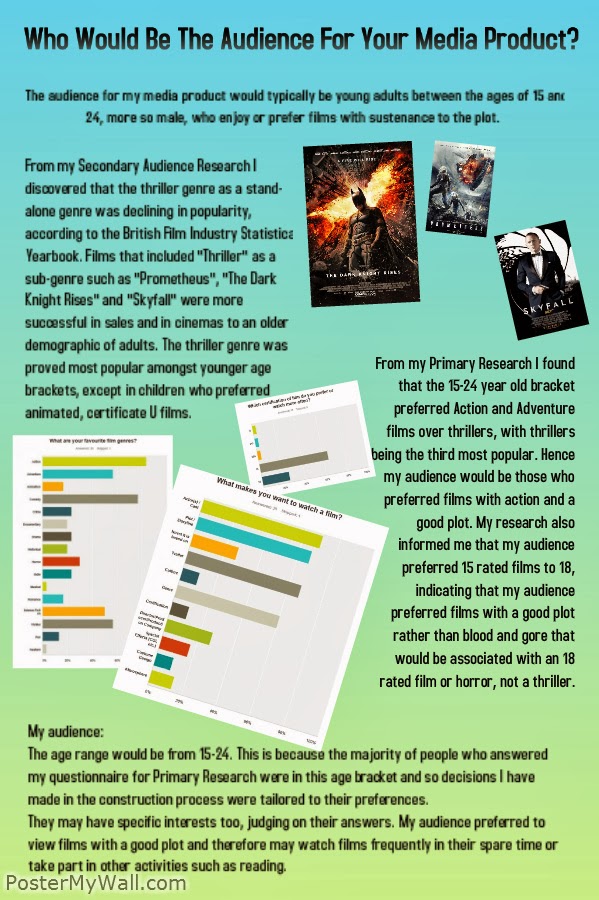
Produced using PosterMyWall.
Evaluation - Question 1 (Updated)
In what ways does your Media Product use, develop or challenge forms + conventions of Real Media Products?
http://padlet.com/wall/rm32gw7h3n
http://padlet.com/wall/rm32gw7h3n

Wednesday, 5 February 2014
Thriller Opening Sequence - Final Cut - "The Case of Charlotte Adams"
This is the Final Cut of our groups' Thriller's opening sequence, "The Case of Charlotte Adams". For the changes we made to the sequence and why, see here.
Changes from the Rough Cut to the Final Cut
After the rough screening of our Thriller Opening Sequence we constructed a questionnaire for audience feedback, which entailed:
- Gender and Age
- Opinions on Thrillers?
- How do you view Thrillers?
- Was the Soundtrack effective? If not, why?
- Did the opening sequence appeal to you and make you want to watch the movie further?
- Were the titles used effectively?
- Could you spot any continuity errors, if so where?
- Any improvements?
With this feedback, we proceeded to change a few aspects of our thriller to the final cut. First, we moved the title text and transition at the end ("The Case of Charlotte Adams") so it appeared over the last shot of the Detective looking around the room with the notes on it. This also helped to create a link between what was in the room and the title, i.e. the Case, so the editing allowed for the meaning to be slightly more apparent to the audience. We then edited the final scene of the forest/chase segment, where the Detective is spinning. Our feedback and personal judgement resulted in us concluding the shot was too blurry and went on for too long to be effective, so instead we replicated the shot where he spins at first, with the two shades standing in a semi circle in front of him, and reversed it, so he spins one way and then spins back. Ellie added a transition here that resulted in the Shades being strecthed and distorted, to make them appear like entities. This could be considered similar to in our inspiration films, Shutter Island and Seven, where characters are envisioned and their appearances are distorted (i.e. the children in Shutter Island at the Concentration Camp), and also similar to the Dementors from Harry Potter that I mentioned in the character profile. Not only did this cut the overall time of the sequence by several seconds, it made it flow more and become more conventional.
My attention then turned to the Soundtrack. Beth and Ellie went into the Soundproof room to record a gasping sound effect for when the Detective wakes up (with the help of a member of another group, as it had to be a male) whilst I fine-tuned the Soundtrack around the action. This invovled getting the timings of the loud crashes to exactly match the Shades appearances in both the Street section (First Encounter) and then in the field (Final Encounter). I also made the section where the faster pace kicks in, after the Ribbon is picked up, much quieter. Not only does this emphasise the difference when the Shade appears, it builds suspense as the kicks in the pattern are subtle enough to be almost like a heartbeat, and adds to the dramatic effect of the sequence. I changed the tempo of various sections to ensure that timings were correct and also adjusted volume levels of small layers of the soundtrack, such as the piano note when the Ribbon is picked up. We then added the gasp effect in Final Cut, as after several attemps in Audacity, even though it was at the correct timing, the exported version had the gasp in an entirely different location. In Final Cut, we then reduced the volume to make it more realistic and sound as if the character is more startled rather than completely exaggerated and fake.
This was all we had to correct to reach a completed version that we were happy with, and as a group are very happy with the outcome.
My attention then turned to the Soundtrack. Beth and Ellie went into the Soundproof room to record a gasping sound effect for when the Detective wakes up (with the help of a member of another group, as it had to be a male) whilst I fine-tuned the Soundtrack around the action. This invovled getting the timings of the loud crashes to exactly match the Shades appearances in both the Street section (First Encounter) and then in the field (Final Encounter). I also made the section where the faster pace kicks in, after the Ribbon is picked up, much quieter. Not only does this emphasise the difference when the Shade appears, it builds suspense as the kicks in the pattern are subtle enough to be almost like a heartbeat, and adds to the dramatic effect of the sequence. I changed the tempo of various sections to ensure that timings were correct and also adjusted volume levels of small layers of the soundtrack, such as the piano note when the Ribbon is picked up. We then added the gasp effect in Final Cut, as after several attemps in Audacity, even though it was at the correct timing, the exported version had the gasp in an entirely different location. In Final Cut, we then reduced the volume to make it more realistic and sound as if the character is more startled rather than completely exaggerated and fake.
This was all we had to correct to reach a completed version that we were happy with, and as a group are very happy with the outcome.
Approaching the Evaluation - Methods of Presentation
In today's lesson we started looking at the Evaluation process and how to approach each of the Evaluation questions. There are seven questions to be answered in total, and I intend to answer each of them through a different media. The questions are:
- In what ways does your media product use, develop or challenge forms and conventions of real media products?
At first I considered doing a podcast or commentary to do this question, but I feel a form of media such as Padlet would be effective to build a "Wall" on all the different aspects this question involves, such as the impact of research, and how different parts of my thriller adhere to different conventions, i.e. location, costumes, narrative and so on.
- How does your media product represent particular social groups?
For this question I feel a visual method such as Prezi would be suitable, as here I could separate individual groups, Young Adults and Young Girls in the instance of my thriller and discuss stereotypes used, costumes, and why I chose that with reference to other thriller films. Alternatively I could use SlideShare to produce a presentation on this.
- What kind of media institutions might distribute my media product and why?
This question is relatively short compared to the others with a lack of extensive material to discuss - who distributes thrillers, who I would like to distribute thrillers, where it could be distributed, and why - for this reason I thought a suitable medium would be Gliffy or similar software to create a flowchart to show how decisions influence another and so on to explain my choices.
This question is relatively short compared to the others with a lack of extensive material to discuss - who distributes thrillers, who I would like to distribute thrillers, where it could be distributed, and why - for this reason I thought a suitable medium would be Gliffy or similar software to create a flowchart to show how decisions influence another and so on to explain my choices.
- Who is my Audience for my Thriller?
For this question I need to focus on who my audience is with reference to my previously conducted Audience Research during the planning phase - the age range, their interests, why it relates to thrillers, and so on. I could discuss this question in a directors commentary or use another simple method of presentation to create a poster on who my audience is. I feel this would be more suitable as there would be more to discuss in the next question, how I attracted my audience.
- How did I attract my audience?
In this question I would discuss with reference to my thriller and research examples of things I included from my research in my thriller. I feel the best method to present this would be an edited video or commentary, where I can make a point and then back it up with screenshots from existing thrillers and my own thriller.
- What have I learnt about technologies from the process of Constructing the Thriller?
This question will entail me focusing on different softwares and equipment that I have used in the production of the thriller - I can discuss Final Cut, Audacity, the equipment itself in the filming process and so on, and how I learned to use these technologies. One way of presenting this answer could be through a podcast or voiceover, of myself discussing the advances I have made and the influence of technology on producing media products, yet I could use screenshots or other images to show myself working on the software itself, such as in Audacity and Final Cut. Alternatively therefore I could use a presentation software such as AuthorStream or EverNote.
- Looking back at the Pre-liminary task, what progression have I made to end up producing my Thriller?
In this question I will answer how I avoided making similar mistakes to in my pre-liminary task, with anything including continuity, soundtrack, characters and so on, as well as editing and the improvements made to my knowledge of the techniques. As with the previous question I could do a podcast or commentary to highlight my use of better planning, storyboarding, decision making, creativity, and production, or use software such as Word It Out / Wordle to produce a concept map highlight each area of progression.
Wednesday, 22 January 2014
Thriller Opening Sequence - Rough Cut - The Case of Charlotte Adams
This is the Rough Cut of the opening sequence to our Thriller, "The Case of Charlotte Adams"
Subscribe to:
Posts (Atom)